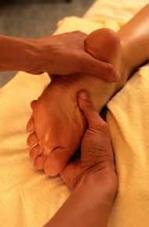
Massage helps Anorexia symptoms
Massage alleviates anxiety, depression, eating disorder symptoms, poor body image and biochemical abnormalities for women diagnosed with anorexia nervosa, according to a recent research study.
Date: 07/30/04
Source: Touch Research Institute
"Anorexia Nervosa Symptoms are Reduced by Massage Therapy" was conducted by researchers at the Touch Research Institute at the University of Miami School of Medicine. It was originally published in Eating Disorders: The Journal of Treatment and Prevention.
Nineteen women undergoing inpatient or outpatient treatment for anorexia nervosa were randomly assigned by researchers to either a massage-therapy group or a standard-treatment group. In addition to receiving standard care, the women in the massage-therapy group received a 30-minute Swedish massage twice a week for five weeks.
Beginning in the supine position, the head and neck were massaged, followed by the arms, torso, legs and feet. In the prone position, the legs and back were massaged. Inpatients in the standard-treatment only group participated in daily individual- and group-therapy sessions, worked with a dietician and engaged in movement therapy.
The women in the outpatient program were under the care of a psychiatrist and attended group therapy. On the first and last days of the study, researchers used the State Anxiety Inventory to evaluate the womens' anxiety levels; the Profile of Mood States to measure their moods; saliva cortisol tests to measure stress-hormone levels; the Center for Epidemiological Studies Depression Scale to determine depression levels; and urine samples to measure dopamine values.
The Eating Disorder Inventory was used to measure psychological and behavioral traits associated with anorexia nervosa, such as perfectionism, drive for thinness, interpersonal distrust and body dissatisfaction. After the five-week treatment period, the massage-therapy group had lower scores on the Eating Disorder Inventory, compared to the standard-treatment group. (Higher scores suggest more symptoms associated with anorexia nervosa.)
Although improved mood was reported by women in the massage-therapy group, no changes were found in depression scores for either the massage-therapy or standard-treatment only group. The study suggests that a longer massage treatment period may be necessary to reduce depression for women with anorexia nervosa. "That the Eating Disorder Inventory (EDI) scores were unchanged for the participants in the control group despite receiving standard treatment … is suggestive of the difficulty of treating eating disorders with only traditional therapies," state the study's authors.
Urine samples taken on the first and last days of the study revealed an increase in dopamine values for the women who received massage therapy in addition to standard care. "Dopamine depletion has been associated with a decrease in food intake and has been implicated in anorexia nervosa and feeding behaviors," state the authors. The results of this study, according to its authors, "suggest that massage therapy added to standard care may be effective for healing mind and body issues for individuals with eating disorders." - Source: The Touch Research Institute.
Authors:
Sybil Hart, Ph.D.;
Tiffany Field, Ph.D.;
Maria Hernandez-Reif, Ph.D.;
Graciela Nearing, Psy.D.;
Seana Shaw, M.D.;
Saul Schanberg, M.D., Ph.D.;
Cynthia Kuhn, Ph.D.
Originally published in Eating Disorders: The Journal of Treatment and Prevention, 2001, Vol. 9, pp. .
|